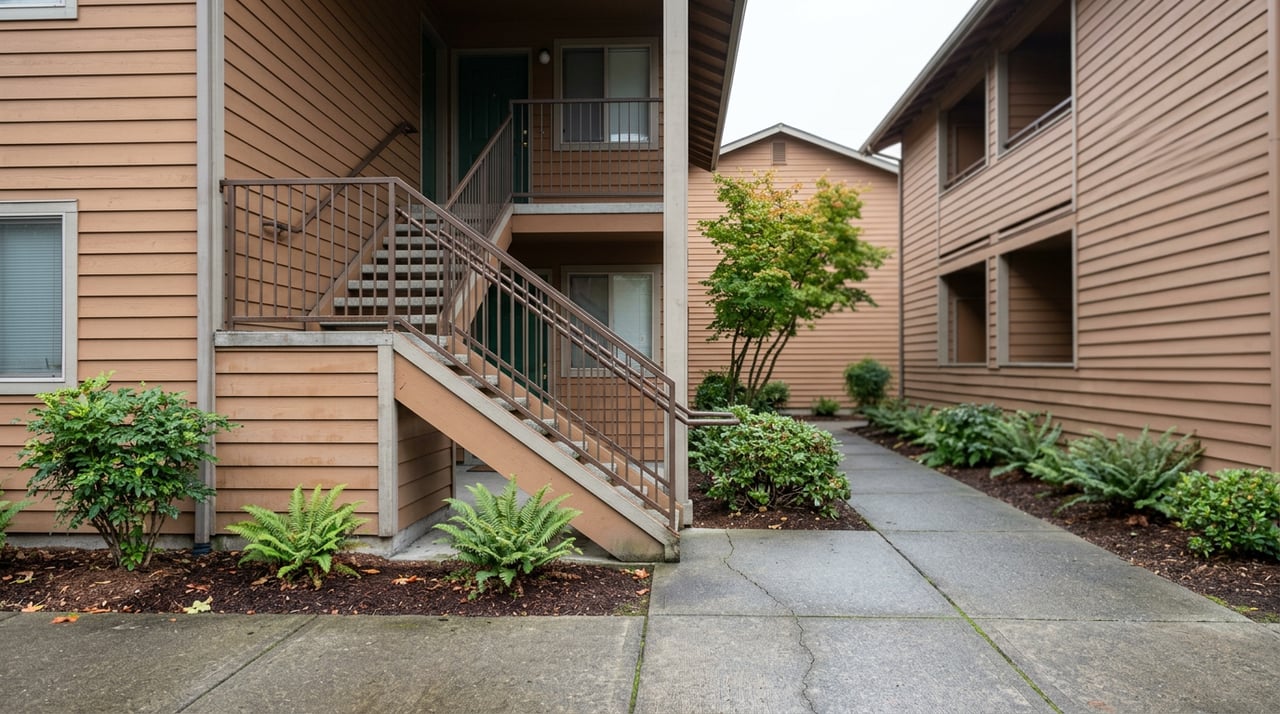
Walk a few blocks off Central Way and you'll pass a run of three-story condo buildings that look interchangeable from the sidewalk: cedar-toned siding, shared parking courts, a landscaped strip along the walkway. A buyer touring one of these places this year and comparing it to a brand-new unit a few blocks away might reasonably assume the older building is the simpler purchase. Lower price, established HOA, nothing to figure out. That assumption stopped being reliable on January 1, 2026.
A new state law took effect that day and it reaches directly into buildings like these, the kind that make up most of Kirkland's condo inventory. It doesn't touch the price. It touches something buyers and sellers rarely think to check until it becomes a problem mid-escrow: whether the association actually knows what its own building will cost to maintain.
Kirkland's Condo Stock Is Older Than It Looks
Kirkland's downtown and the surrounding Moss Bay area hold thousands of condo and apartment units, and most of that inventory has gone up since the 1990s. But a meaningful slice of what's still on the market today is older than that, built in the 1970s and 80s, decades before anyone was writing statutes about reserve funding:
| Complex | Year Built | Age in 2026 |
|---|---|---|
| Juanita Bay | 1976 | 50 years |
| Cedar Mill | 1977 | 49 years |
| Falcon Ridge | 1979 | 47 years |
| Arrowood | 1980 | 46 years |
| Cambridge Place | 1982 | 44 years |
| Esplanade | 1986 | 40 years |
None of these were required to run a reserve study when they were built. For most of their existence, they weren't required to run one at all. That changed this year, and the reason has nothing to do with the buildings themselves. It has to do with a date on the calendar that most owners never noticed.
The July 2018 Line Just Moved
Washington has been running two parallel systems for common interest communities. Buildings formed after a certain point fall under the newer Washington Uniform Common Interest Ownership Act, or WUCIOA. Buildings formed before July 1, 2018 were allowed to keep operating under the older condo and HOA statutes, with a full transition to WUCIOA not required until 2028.
That eight-year runway got a lot shorter. In 2025 the legislature passed a bill, ESSB 5129, signed into law on April 22, 2025, that accelerated a specific set of WUCIOA provisions for the older, pre-2018 buildings. Nine sections of the newer law now apply to those associations as of January 1, 2026, years ahead of the original 2028 deadline. One of those nine sections is the reserve study requirement.
In practical terms, an association like Cedar Mill or Cambridge Place, formed in the 1970s or 80s under the old rules, is now bound by the same reserve study mandate as a building built last year. The buildings didn't get newer. The law got applied backward.
This isn't a Kirkland-specific rule. It's a statewide change reaching more than 10,500 community associations and roughly 2.3 million residents. What makes it a Kirkland story is the concentration: a downtown built out largely before 2018 means a higher share of local condo owners are hitting this requirement for the first time, all at once, in the same calendar year.
What the Reserve Study Actually Requires
A reserve study isn't a formality. Under the schedule that now applies, associations are expected to update their reserve projections annually, with a full study that includes an on-site inspection by a reserve professional at least every three years. That means a board that has never ordered one now needs to commission an inspection, price out every major system in the building (roofing, siding, plumbing, elevators if it has them), and produce a funding plan showing whether current dues cover the eventual bill.
For a self-managed, volunteer-run association in a 46-year-old building, that's not a form to fill out. It's a project, and it takes months.
There's an escape valve. An association can vote to waive the requirement, but only with a two-thirds vote of the owners, and that vote has to be renewed every three years. It's not a one-time opt-out. It's a recurring decision the board has to keep making, on the record, indefinitely.
An association that has gone decades without ever pricing out its own roof replacement is not the same purchase as one that already knows the number.
The Gap in the Paperwork Buyers Need to Ask About
Here's where it gets more specific than most guides to this law get, and where a buyer or listing agent working an older Kirkland building needs to pay attention.
WUCIOA also expands what has to appear on a resale certificate, the document a buyer receives before closing that lays out the association's finances, insurance, litigation history, and reserve status. The newer version of this document covers 26 separate disclosure categories. But that expanded disclosure requirement is not one of the nine sections accelerated by ESSB 5129. It's scheduled to reach pre-2018 buildings on the same 2028 timeline as the rest of the WUCIOA transition, not the accelerated 2026 timeline that applies to the reserve study itself.
That creates a real gap for this year and next. An older Kirkland association is now legally required to have a current reserve study. But the resale certificate format that association hands a buyer isn't yet required to be built around disclosing it the way a newer building's would be. The obligation to have the study exists. The paperwork prompting the seller to hand it over in a standardized way doesn't fully exist yet.
The practical takeaway: don't assume the resale certificate alone tells the whole story in a pre-2018 building. Ask the association directly whether it has commissioned its reserve study, when the last update happened, and whether the board has taken a waiver vote instead. That question belongs in the offer stage, not the inspection period, because a board that's still scrambling to order its first professional reserve study can add real weeks to a closing timeline that a buyer didn't budget for.
New Construction Skips the Catch-Up
The contrast shows up clearly a few blocks away, where Cordillera Homes broke ground on Central Peak Residences, a collection of 26 condominiums at Central Way and Lake Street on the site of a former U.S. Bank. Cordillera Homes is the residential division of the Kirkland-based Cordillera Group, and its principal and president, Nick Tosti, called the groundbreaking "the culmination of years of careful planning and design."
A building like Central Peak was formed after WUCIOA already existed. It never operated under the old two-tier system, so there's no catch-up requirement, no board scrambling to order a first-ever inspection, no waiver vote to schedule. The reserve study framework was built into its governance from day one.
That's not an argument for buying new over old. It's a reminder that in 2026, the age of a Kirkland condo building affects more than its finishes and floor plan. It affects the paperwork timeline and the financial homework a buyer needs to do before writing an offer.
What to Do If You're Buying or Selling This Year
If you're selling in a pre-2018 building:
- Ask your board now, not after you list, whether a reserve study has been ordered or completed
- If the association has taken a waiver vote instead, get the date of that vote and confirm it's still current
- Expect buyers and their agents to ask about this directly, since the resale certificate itself may not prompt the question yet
If you're buying in a pre-2018 building:
- Request the reserve study, or documentation of a waiver vote, as part of your offer terms rather than waiting for the resale certificate to surface it
- Ask when the last on-site inspection happened, since the standard is a full inspection at least every three years with annual updates in between
- Budget extra time in your closing timeline if the association is still working through this for the first time
None of this is legal or financial advice. Every association's documents and timeline are different, and a closing attorney or the association's management company can confirm exactly where a specific building stands.
FAQ
Does this law apply to townhomes and HOAs, or just condos? It reaches condominiums, homeowners associations, and other planned communities across Washington, not just high-rise or mid-rise condo buildings. Older platted HOA communities are subject to the same accelerated timeline.
If a building already has a reserve study, does anything change? Not much operationally. The bigger shift is for associations that never had one and now have to produce their first.
Can a sale still close if the association hasn't completed its reserve study yet? The law doesn't halt sales over this, but a buyer who asks the right questions early can avoid discovering a funding gap or a stalled compliance process after they're already under contract.
When does the rest of WUCIOA apply to these older buildings? The broader transition, including the expanded resale certificate disclosures, is scheduled for January 1, 2028. The reserve study requirement is the piece that arrived early.
If you're weighing an older condo against new construction in Kirkland, or you're a board member trying to figure out what this law actually requires of your building, Wanis Nadir can walk through the specific documents your association or your target building has on file before you write an offer or sign a listing agreement.